Expressions
An expression computes a value. It appears in conditions, assignments, arguments, return
statements, values properties and where clauses. FML expressions are evaluated by Connie,
the expression language of the platform: they look like Java expressions, and they mostly behave
like them, with a few differences that matter. This page lists the operators, then the differences.
The examples come from a model Calc.
Values
An expression works with numbers (7, 1.5), strings ("a"), booleans (true, false),
null, and the instances of concepts. A path designates a value by following properties and
calls: guest.name, fiction.books.size, this.container.label. The names a path can start from
are the local variables, the properties of the concept, and this, container and parameters
(see the language tour). Inside a listen, evt is the event.
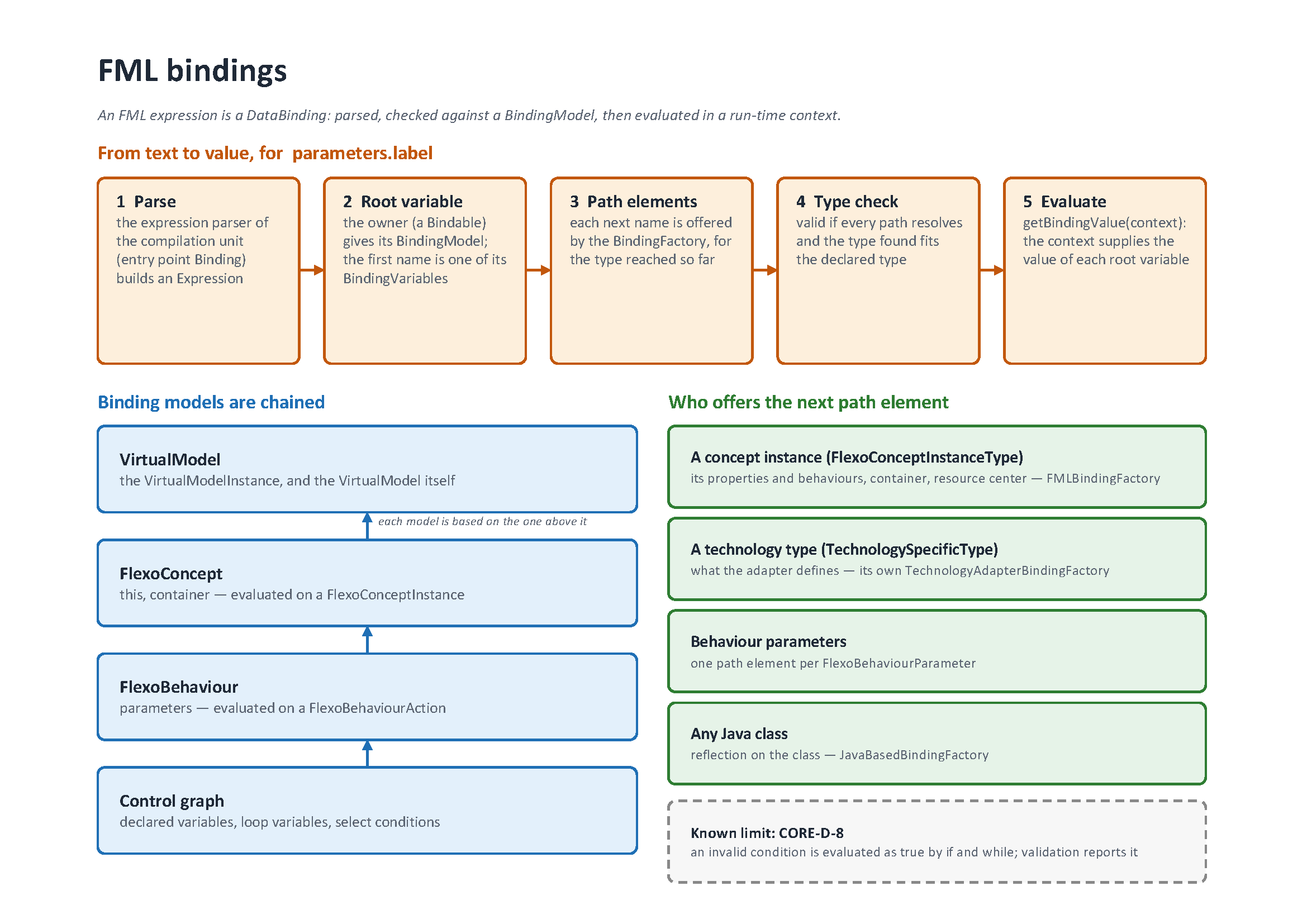
Resolving a path is: parse the text into an expression, find its first name in the binding model
in scope, resolve each further step against the type found so far, then evaluate it. The binding
model in scope inside a control graph is itself a chain — a VirtualModel's, then its
FlexoConcept's, then a FlexoBehaviour's, then the control graph's own — each adding its names
to those of the one before it. The language tour
measures the resulting lookup order for a bare name inside a behaviour.
Operators
| Kind | Operators |
|---|---|
| arithmetic | + - * / %, and - before a value |
| comparison | == != < <= > >= |
| logic | && ` |
| conditional | condition ? a : b |
| type | instanceof, and a cast (type) value |
Precedence is the usual one, and parentheses group:
public int precedence() {
	return 2 + 3 * 4;
}

public int parens() {
	return (2 + 3) * 4;
}
assert calc.precedence() == 14;
assert calc.parens() == 20;
Conditional expressions can be nested:
public String ternary(int n) {
	return parameters.n > 0 ? "pos" : (parameters.n < 0 ? "neg" : "zero");
}
assert calc.ternary(5) == "pos";
assert calc.ternary(-1) == "neg";
assert calc.ternary(0) == "zero";
&& and || evaluate both operands, as the control flow page
shows.
Numbers
Division and remainder give decimal numbers, even between integers. 7 / 2 is 3.5, not 3,
6 / 3 is 2.0, and 7 % 2 is 1.0. The declared type of the behaviour does not change that:
public double intDiv() {
	return 7 / 2;
}

public double evenDiv() {
	return 6 / 3;
}

public double intMod() {
	return 7 % 2;
}
assert calc.intDiv() == 3.5;
assert calc.evenDiv() == 2.0;
assert calc.intMod() == 1.0;
Addition, subtraction and multiplication between integers stay integers, and mixing an integer with a decimal gives a decimal:
public double mixed() {
	return 3 * 1.5;
}
assert calc.mixed() == 4.5;
To get an integer from a decimal, use a cast, which drops the decimals:
public int castInt() {
	double d = 3.7;
	return (int) d;
}
assert calc.castInt() == 3;
A string is never a number. "4.5" * 1.0 is an error. To convert, call a Java method: import
the class, and use its simple name.
import java.lang.Double;
public double parsed() {
	return Double.parseDouble("4.5") * 2;
}
assert calc.parsed() == 9.0;
Strings
+ concatenates when its left operand is a string, and a number or null on the right is
written as text; null is written null:
public String concatNumber() {
	return "a" + 1;
}

public String nullConcat() {
	String n = null;
	return "x" + n;
}
assert calc.concatNumber() == "a1";
assert calc.nullConcat() == "xnull";
The other way round, 1 + "a", is a type error and stops the behaviour.
== compares the contents of two strings, not their identity:
public boolean stringEq() {
	String a = "ab";
	String b = "a" + "b";
	return a == b;
}
assert calc.stringEq();
The Java methods of a string are available on a variable or a parameter. null is tested with
== null:
public String upperLocal() {
	String s = "abc";
	return s.toUpperCase();
}

public String replaceLocal() {
	String s = "EQ-12-3";
	return s.replace("EQ-", "").replace("-", "");
}

public int lengthOf(String s) {
	return parameters.s.length();
}

public boolean isNull() {
	String n = null;
	return n == null;
}
assert calc.upperLocal() == "ABC";
assert calc.replaceLocal() == "123";
assert calc.lengthOf("hello") == 5;
assert calc.isNull();
A method called directly on a string literal, "hello".length(), gives null, with no message.
Put the literal in a variable first, as upperLocal does.
Lists
A Java list is created with new ArrayList<Type>() and used with its Java methods:
public int listSize() {
	List<String> l = new ArrayList<String>();
	l.add("a");
	l.add("b");
	return l.size();
}

public String listGet() {
	List<String> l = new ArrayList<String>();
	l.add("a");
	l.add("b");
	return l.get(1);
}

public boolean listContains() {
	List<String> l = new ArrayList<String>();
	l.add("a");
	return l.contains("a");
}
assert calc.listSize() == 2;
assert calc.listGet() == "b";
assert calc.listContains();
When a path does not resolve
A path that cannot be resolved is not always an error: in a behaviour it gives null, and the
behaviour goes on. Several mistakes end this way, and are covered on the pages where they arise:
| The mistake | Instead |
|---|---|
a parameter read by its bare name, who | parameters.who |
a behaviour of the same instance called bare, twin() | this.twin() |
| a concept of another model used without importing it | import [uri]; |
a concept that is not nested created with a bare new | container.new |
super.name() in a concept with several parents | a helper behaviour called on this |
| a method called on a string literal | a variable |
When a value is null and should not be, look for one of these first, and validate the model, which
reports unresolved paths.
What you have seen
Expressions read like Java, with the usual precedence and a conditional operator. Division and
remainder give decimal numbers, a string is never converted to a number, + with a string on the
left concatenates, and both sides of && and || are evaluated. A path that does not resolve gives
null rather than an error, which is the first thing to suspect when a value is missing.
The model and script (Calc.fml and TestCalc.fmlscript) are tests of the platform, in the
openflexo-core repository.