Virtual models and concepts
A federation in Openflexo is described by a virtual model. This page explains what it is made of:
concepts, which have properties (what an instance knows) and behaviours (what it can
do), and how those descriptions become objects when the model runs. It uses the vocabulary of the
FML language; the examples are excerpts of a small library model, Library,
that the platform's automated tests load and run.
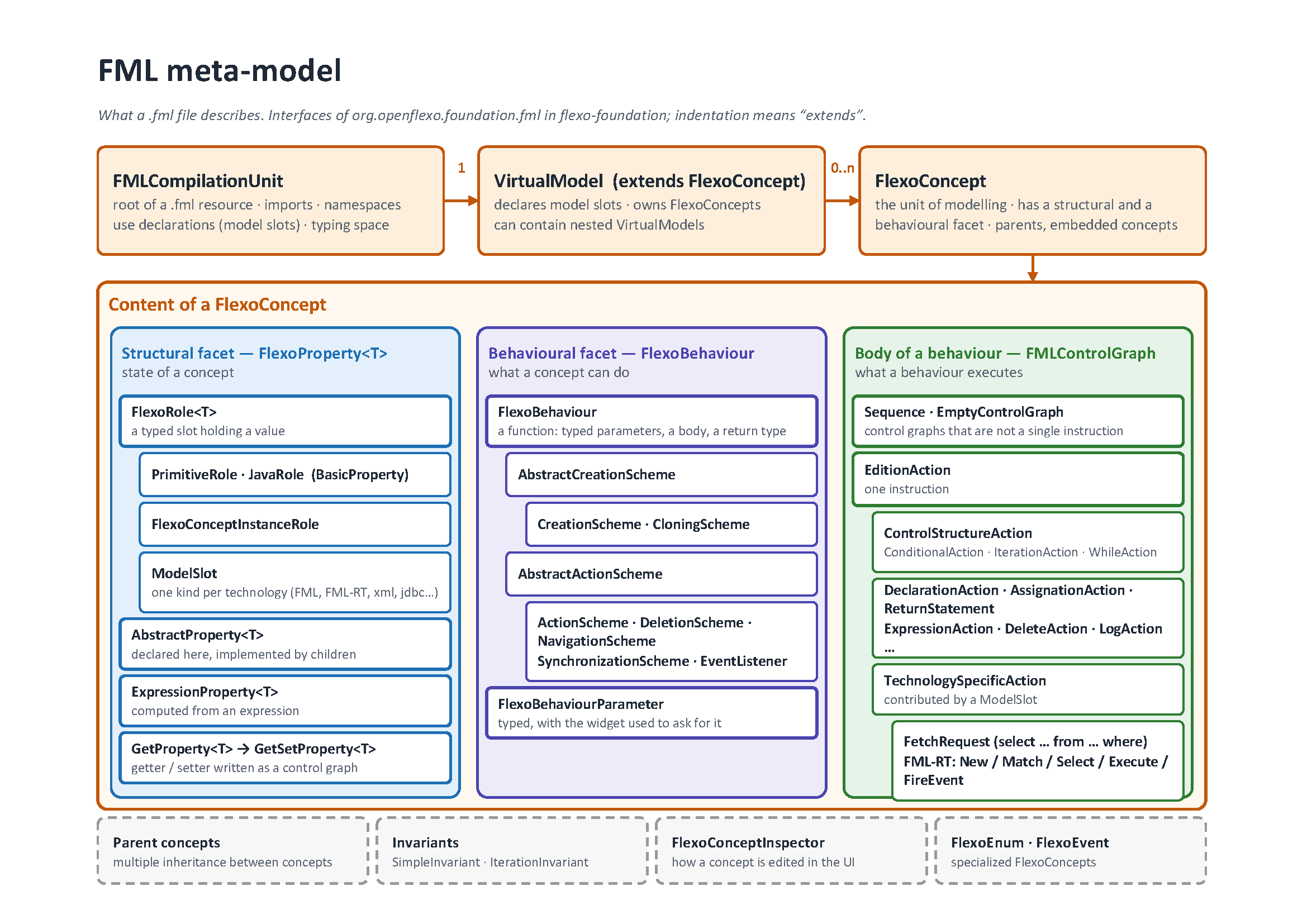
A .fml file is a compilation unit that declares one VirtualModel, which contains
FlexoConcepts. Inside a FlexoConcept are its properties, its behaviours, and, as the
body of each behaviour, a control graph — the sequence of statements it runs (covered on
control flow and instructions).
Two levels: describing and running
Everything on this page exists at two levels.
- The model level is what you write in FML: virtual models and concepts. They are types.
- The run-time level is what exists when the model runs: virtual model instances and concept instances, created from the types. They hold the values.
The names follow each other: a virtual model has instances, a concept (formally a flexo concept) has instances. And a virtual model is a concept: it can do everything a concept does, and it is also the unit that groups concepts and that you instantiate to start using them. A virtual model instance is, likewise, a concept instance.
If you know an object-oriented language, a concept plays the part of a class, its properties are the attributes and its behaviours are the methods. Three things go beyond that: concepts contain other concepts, properties can point at data that lives outside the model, and behaviours can react to what happens in the resources a model federates.
Each model-level notion has its run-time counterpart: a VirtualModel is instantiated as a
VirtualModelInstance, a FlexoConcept as a FlexoConceptInstance, and a FlexoRole (a property
bound to a resource) as an ActorReference. A FlexoBehaviour's counterpart is more short-lived:
each time it runs, it does so as a FlexoBehaviourAction.
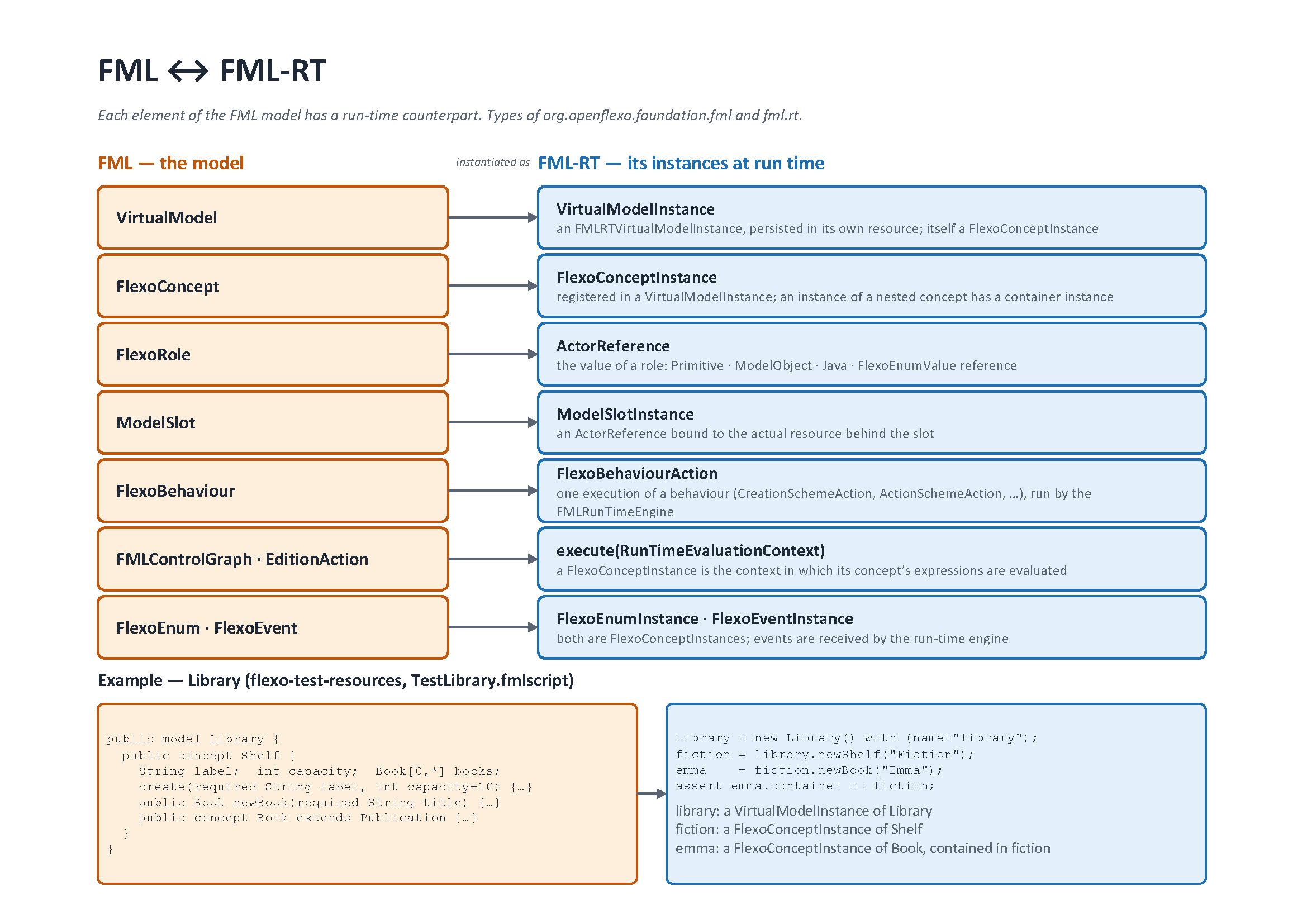
In the running example of this page, Library is instantiated as library, its concept Shelf
as fiction, and Shelf's concept Book as emma.
Containment
Every concept is declared inside a container: the virtual model, or another concept. At run time, the instances follow the same nesting: an instance of a concept lives inside an instance of its container.
In Library, the concept Shelf is declared in the virtual model, and the concepts Book and
Novel are declared in Shelf:
public model Library {
	// …
	public concept Shelf {
		// …
		public concept Book extends Publication {
			// …
		}

		public concept Novel extends Book {
			// …
		}
	}
}
The nesting shows in the address of a concept, …/Library.fml#Shelf#Book, and in the instances:
a book created by a shelf is contained in that shelf.
fiction = library.newShelf("Fiction");
emma = fiction.newBook("Emma");
assert emma.container == fiction;
Properties
A property describes something an instance knows. Shelf declares five of the kinds a concept can
have:
public concept Shelf {

	String label;
	int capacity;
	Book[0,*] books;
	int bookCount values books.size;
	private String notes;

	String displayName {
		String get() {
			return "Shelf " + label;
		}
		set(String value) {
			label = value;
		}
	};
	// …
}
| Kind | Declaration | What it is |
|---|---|---|
| Stored | String label;, int capacity; | a value the instance holds, of a primitive or Java type |
| Reference to concept instances | Book[0,*] books; | instances of a concept; the cardinality tells how many, [0,*] meaning any number |
| Computed | int bookCount values books.size; | read-only, computed from an expression over other properties |
| Get and set | String displayName { … }; | a value computed by a get() and, optionally, changed by a set(…) |
| Abstract | abstract String code; | declared by a concept, given its value by the concepts that extend it |
A visibility keyword (private, protected, public) precedes the type; without one, the property
has the default visibility.
At run time these give, for a shelf fiction holding two books:
assert fiction.books.size == 2;
assert fiction.bookCount == 2;
assert fiction.displayName == "Shelf Fiction";
fiction.rename("Classics");
assert fiction.label == "Classics";
A property can also be bound to an element of an external resource: a cell of a spreadsheet, an XML element, a class of an EMF model. This is what connects a virtual model to the data it federates, and it is described with the technology adapters.
Behaviours
A behaviour describes what an instance can do. Its body is a sequence of instructions (assignments,
conditions, loops, and the edition actions that create, query or delete things). Shelf shows
the main kinds.
Creation. A create behaviour runs when an instance is created with new. A concept may have
several; all but one are named:
create(required String label, int capacity=10) {
	label = parameters.label;
	capacity = parameters.capacity;
}

create::withDefaultCapacity(String label) {
	label = parameters.label;
	capacity = 10;
}
new Shelf("Fiction", 20) runs the first one, and new Shelf::withDefaultCapacity("Poetry") the
second.
Deletion. A delete behaviour runs when an instance is deleted, with the delete instruction:
public removeBook(Book book) {
	books.remove(parameters.book);
	delete parameters.book;
}
Ordinary behaviours. Any other behaviour has a name, arguments and possibly a return type. It is called on an instance, like a method:
public int countNovels() {
	int count = 0;
	for (Book book : books) {
		if (book instanceof Novel) {
			count = count + 1;
		}
	}
	return count;
}
Reactions. A behaviour can also be triggered by an event instead of being called. Library
declares an event and reacts to it:
public Shelf newShelf(String label) {
	Shelf shelf = new Shelf(parameters.label, 20);
	fire new ShelfCreated(parameters.label);
	return shelf;
}

listen ShelfCreated from this {
	lastCreatedShelf = evt.label;
}

event ShelfCreated {
	String label;
	create(String label) {
		label = parameters.label;
	}
}
After library.newShelf("Fiction"), library.lastCreatedShelf is "Fiction". Events are not
limited to the model itself: technology adapters can offer events of their own, fired when the
federated resource changes, and a model listens to them the same way.
A behaviour reads its arguments through parameters, as in parameters.label. Writing the bare
name gives null, without an error (see the language tour).
Inheritance
A concept can extend one or several other concepts, and can be abstract. In Library, Publication
is abstract and declares that every publication has a code; Book extends it and computes the
code from its title; Novel extends Book:
public abstract concept Publication {

	abstract String code;
}
public concept Book extends Publication {

	String title;
	String code values "B-" + title;
	// …
}

public concept Novel extends Book {

	String author;

	create(String title, String author) {
		super(parameters.title);
		author = parameters.author;
	}
	// …
}
A novel is a book and a publication: the checks below hold, and Shelf.countNovels() above counts
novels among the books with instanceof.
dune = fiction.newNovel("Dune", "Frank Herbert");
assert dune.code == "B-Dune";
assert fiction.countNovels() == 1;
What you have seen
A virtual model groups concepts, and is itself a concept. Concepts nest, and their instances nest the same way. A concept declares properties, which can be stored, referenced, computed or abstract, and behaviours, which can create, delete, compute or react. The model is a description: the values exist only in the instances the runtime creates from it.
The model Library and the script that checks every value above (Library.fml and
TestLibrary.fmlscript) are part of the automated tests of the openflexo-core repository.