Engineering Digital Twins (EDT)
Problem
Digital twins bring together models, simulation, data-driven techniques and AI across software engineering, numerical analysis, HPC, distributed and embedded systems, and human-computer interaction. Building them today still lacks shared scientific foundations, a common use-case catalog, and a platform that federates the many tools and models involved.
Contribution
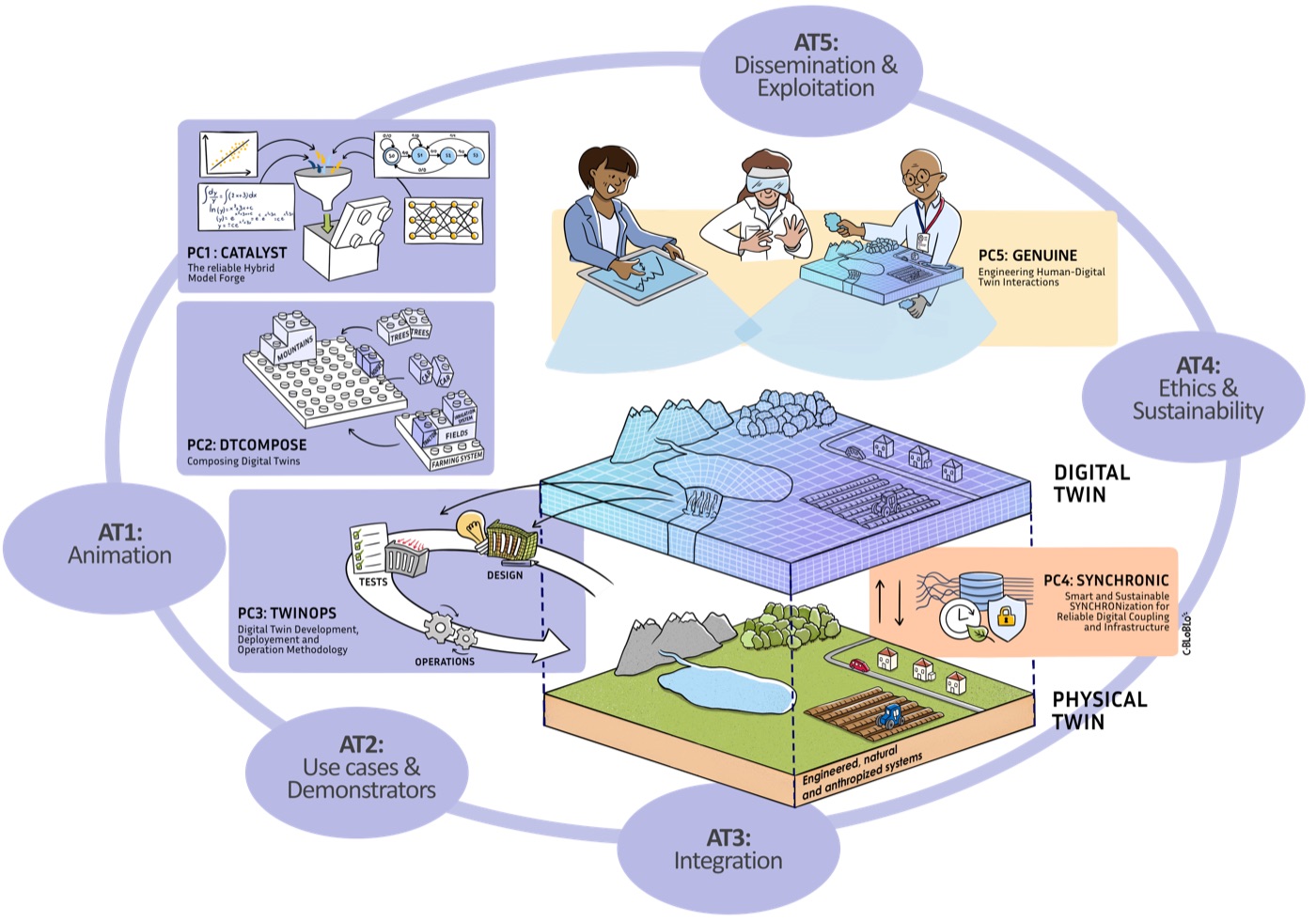
EDT is a French national research program, funded by France 2030, running for six years from January 2026. It aims to establish the scientific foundations of digital twin engineering, build an international scientific and technological community, maintain a public catalog of digital twin engineering use cases, and deliver Artemis, a collaborative web-based platform for engineering digital twins. The program is structured around five Focused Projects (PC1-PC5) and five Cross-Cutting Actions (AT1-AT5). IMT Atlantique contributes with OpenFlexo to three of them: PC1 (hybrid physical/data-based model forging), PC2 (composing and federating digital twins) and PC3 (methodologies, life cycles and domain-specific languages for engineering digital twins).
Partners
EDT is led by Inria and funded by France 2030 / ANR, with about forty funding, research and external/industrial partners. Leaders of the Focused Projects:
- PC1 — Catalyst: Julien Deantoni (Université Côte d'Azur)
- PC2 — DTCompose: Jean-Marc Jézéquel (Université de Rennes / Inria), Jannik Laval (Université de Lyon)
- PC3 — TwinOps: Jean-Michel Bruel (Université Toulouse Jean Jaurès), Antoine Beugnard (IMT Atlantique)
- PC4 — Synchronic: Hind Bril El Haouzi (Université de Lorraine)
- PC5 — Genuine: Arnaud Blouin (INSA Rennes), Thierry Duval (IMT Atlantique)
The full partner list is on the official website.